

KPMG CTF 2026 - Troll Clock
Challenge Description
Troll Clock claims to be a precision timekeeping service. Synchronize the clock, solve the server’s verification challenge, and retrieve the flag.
Step 1 - Intercepting the WebSocket Traffic
Opening the application in Burp Suite showed that it communicates via WebSockets rather than standard HTTP endpoints:
wss://kicyber-d46e0ec3248f-trollclock-0-0.chals.ioWhen you click the synchronization button, the client sends a clock_sync frame. The server responds with an obfuscated JavaScript verification payload that the browser must execute to produce an answer token.
The UI displays an OTP field on the screen, but that value is cosmetic. The server expects an exact numeric answer calculated from the code challenge transmitted across the socket.
Step 2 - Deobfuscating the Challenge Script
The server returned a self-contained JavaScript function packed with dead code, decoy variables, and misleading comments:
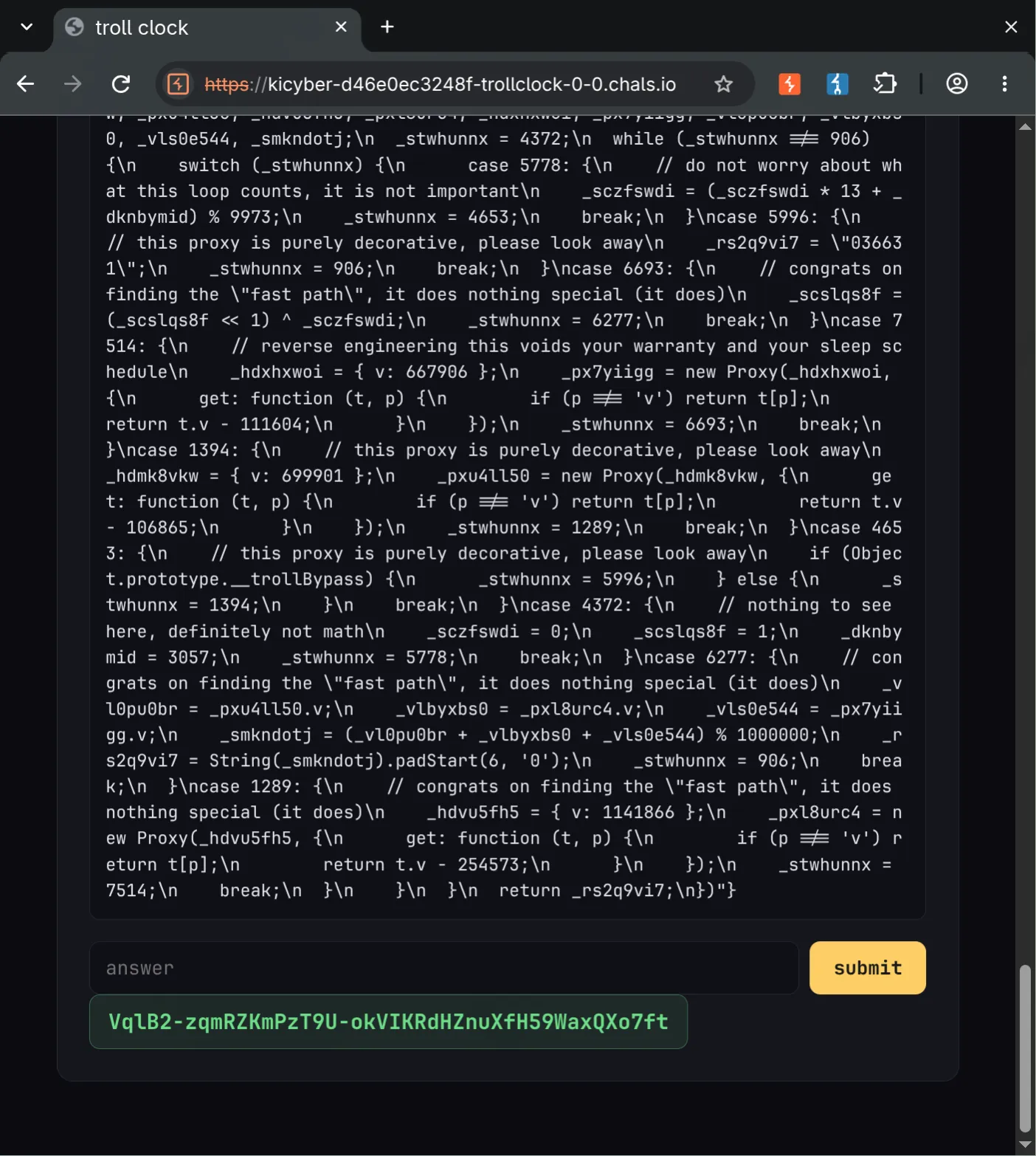
Key traps in the script:
- A
__trollBypasscondition that leads to a hardcoded fake answer - A large
switchstatement with meaningless loop iterations - Fake comments advising the analyst to ignore specific blocks
Cutting through the noise, the script constructs three JavaScript Proxy objects with custom get traps. Each proxy subtracts an offset when accessing .v:
// Block 1
1267876 - 423971 = 843905

// Block 2
1760201 - 872908 = 887293

// Block 3
733419 - 177117 = 556302
The script then sums these three intermediate results:
843905 + 887293 + 556302 = 2287500Finally, it applies a modulo operation:
2287500 % 1000000 = 287500The expected answer for the verification window was 287500.
Step 3 - Submitting the Answer via WebSocket
Using Burp Suite’s WebSocket Repeater, we crafted and sent the response frame:
{
  "type": "submit_window",
  "answer": "287500"
}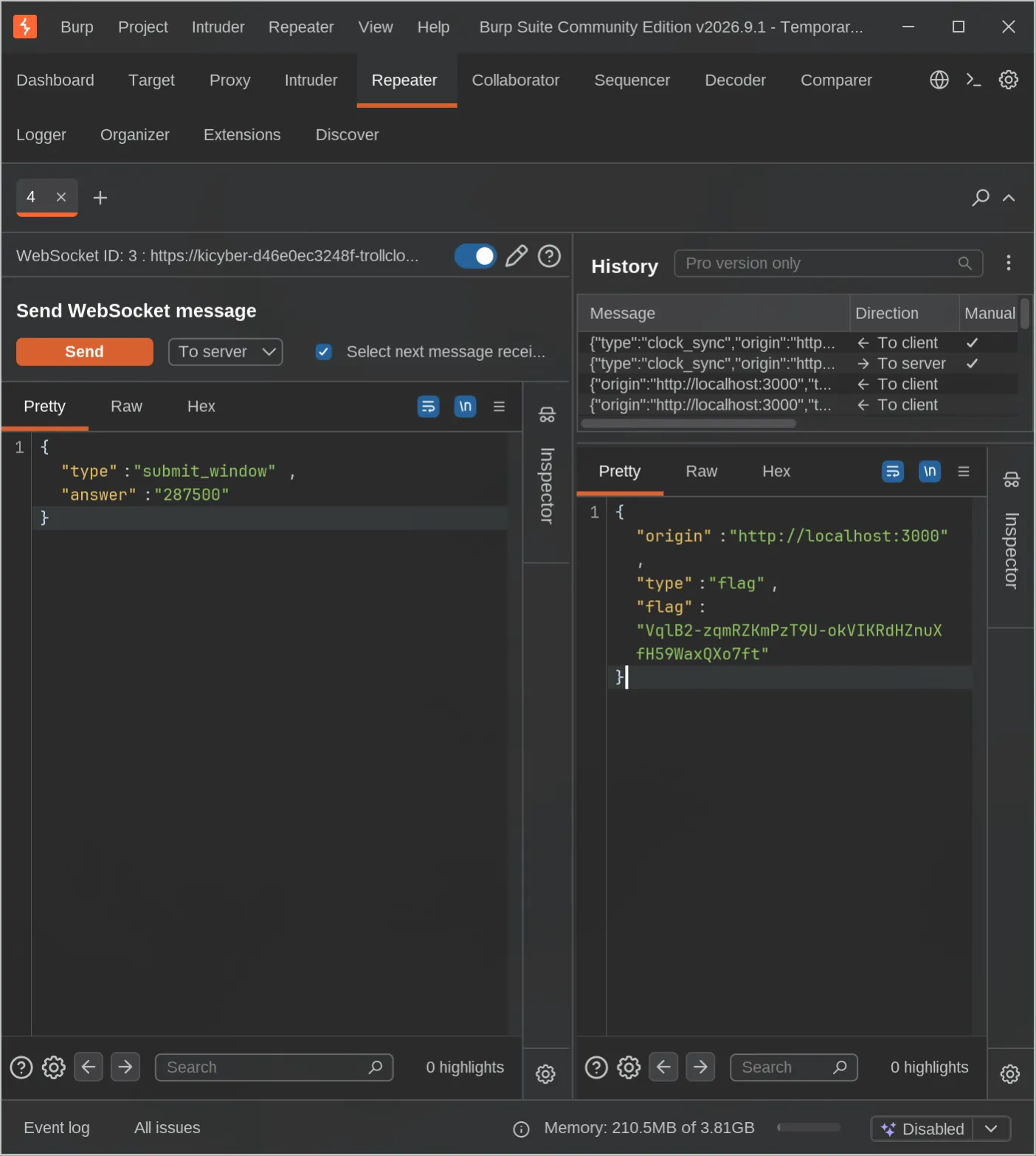
The server immediately verified the calculation and returned the flag frame:
{
  "origin": "http://localhost:3000",
  "type": "flag",
  "flag": "VqlB2-zqmRZKmPzT9U-okVIKRdHZnuXfH59WaxQXo7ft"
}
Flag
KPMG_CTF{VqlB2-zqmRZKmPzT9U-okVIKRdHZnuXfH59WaxQXo7ft}Mitigations
| Vulnerability | Fix |
|---|---|
| Client-side verification | Never rely on client-evaluated scripts or proof-of-work puzzles for sensitive authorization |
| Security through obscurity | Obfuscation and dead-code insertion only delay reverse engineering; enforce validation on the server |
Summary
Troll Clock attempted to deter automated solvers by serving dynamically generated JavaScript challenges over WebSockets. By inspecting the socket frames in Burp Suite and filtering out the control-flow flattening noise, we identified three proxy subtraction routines. Evaluating those operations and taking the modulo yielded the verification token, which returned the flag over the active socket.