

Oracle
Category: Reverse Engineering
Difficulty: Medium
Challenge Overview
Oracle was an ELF reverse engineering challenge where the objective was to understand how the binary validated user input and recovered the embedded flag. Rather than brute-forcing the correct input, the intended solution was to reverse the decoding routine used after a successful hash check.
Approach
Understanding the Validation Logic
After loading the binary into a disassembler, the input validation routine became clear:
- Read user input using
fgets() - Strip the trailing newline
- Require an input length of exactly 19 characters
- Compute a polynomial rolling hash
- Compare the result against the constant
0x9CFB3CEB
Only matching inputs reached the flag decoding function.
Inspecting the Decoder
Tracing the success path revealed another function responsible for reconstructing the flag from encoded bytes stored in the .rodata section.
The decoding formula was:
output[i] = ((hash >> (i & 7)) ^ encoded[i] ^ (i * 31) ^ 0x5A) & 0xFF;Since both the target hash and the encoded bytes were available in the binary, there was no need to recover the original input string.
Recovering the Flag
Instead, I extracted the encoded data directly from the binary and reproduced the decoding routine in Python.
import os

def solve():
    file_path = "oracle"
    if not os.path.exists(file_path):
        print(f"[-] Error: '{file_path}' not found in the current directory.")
        return

    hash_val = 0x9CFB3CEB
    encoded_vaddr = 0x402030
    base_addr = 0x400000 # Standard 64-bit ELF base address
    file_offset = encoded_vaddr - base_addr # Should be 0x2030
    num_bytes = 34

    try:
        with open(file_path, "rb") as f:
            f.seek(file_offset)
            encoded_data = f.read(num_bytes)

        if len(encoded_data) < num_bytes:
            print("[-] Error: Not enough bytes read. Check file offset.")
            return

        print("[+] Encoded bytes extracted successfully.")
        flag = ""

        for i in range(num_bytes):
            shifted_hash = hash_val >> (i & 7)
            dec_byte = (shifted_hash ^ encoded_data[i] ^ (i * 31) ^ 0x5A) & 0xFF
            flag += chr(dec_byte)

        print(f"\n[+] Decoded Flag: {flag}")
    except Exception as e:
        print(f"[-] An error occurred: {e}")

if __name__ == "__main__":
    solve()
Running the script reconstructed the plaintext flag immediately.
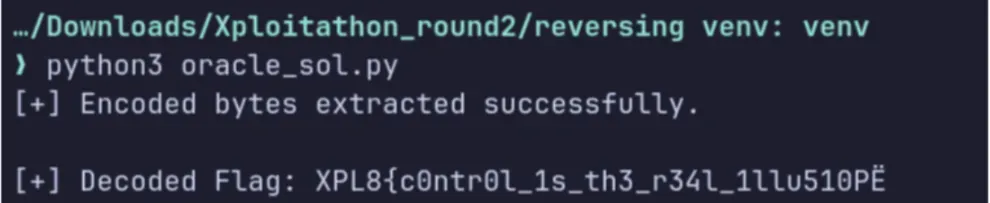
XPL8{c0ntr0l_1s_th3_r34l_1llu510n}Conclusion
Oracle demonstrates a common reverse engineering lesson: passing validation is not always necessary. Once the decoding algorithm and encoded data were identified, recreating the routine externally was significantly easier than finding a valid input that satisfied the hash check.
Flag:
XPL8{c0ntr0l_1s_th3_r34l_1llu510n}