

Fsociety’s Secret
Category: Cryptography
Difficulty: Hard
Challenge Overview
Fsociety’s Secret centered around breaking an improperly configured ElGamal implementation. The challenge intentionally used parameters that made the discrete logarithm problem much easier than intended, allowing the private key to be recovered before decrypting the flag.
Approach
Weak Parameter Generation
The critical observation was that the chosen prime p produced a value of p - 1 with several small prime factors. This made the system vulnerable to the Pohlig–Hellman algorithm, which efficiently solves discrete logarithms whenever the group order is sufficiently smooth.
Factoring p - 1 revealed multiple small factors that could be exploited individually.
Applying the Pohlig–Hellman Algorithm
Instead of attacking the full discrete logarithm directly, the problem was split into several smaller sub-problems. Each subgroup discrete logarithm was solved independently using the Baby-Step Giant-Step algorithm.
This produced a collection of congruences representing the private key modulo each small factor.
Reconstructing the Private Key
With the subgroup solutions available, the Chinese Remainder Theorem (CRT) was used to combine them into the complete ElGamal private key.
After verifying the recovered key against the public parameters, it could be used exactly like the legitimate secret key.
Recovering the AES Key
The recovered private key allowed the ElGamal ciphertext to be decrypted, revealing the 128-bit AES key protecting the final flag.
The remaining ciphertext was encrypted using AES-CBC with a zero initialization vector, so decrypting it with the recovered key immediately produced the plaintext.
Code to solve it
import math
from cryptography.hazmat.primitives.ciphers import Cipher, algorithms, modes
from cryptography.hazmat.backends import default_backend

p = 6149059152047173810929520610252054724434547268293997900228346988632026139296516495540477511197233410835031806302501788817802147338507673010790914591966411034143018465230753723388103315997074066465915406376864167374655977885785821310570662894392390395753471445736267810187903833304863045974238749688245530607
g = 5719275944239987190458421245546229548888846731353398043162644430064597096976159819921524452554095058636720054596231559684320789722962976527976545669345058297524867469181858053038816720679526830291841309662435186455700706221003964190466817684147617948365280845302761388758671140064249106209075533637357263231
A = 2555297614863845215431835415772614784743798924133900800787463671501662222468554222725877277092258849851944927347384717791540169865769130437660089795213081276681792643860918393721387336966064482776321260842945637479291021202655103477316865068516592795061612417388401255868653332471670086454998195709403176041
c1 = 5512928361799616712522312337586877320563049808521259994710385873918851237761731656487251356100346025012478907551450133321786614899546347085949956566607223672838137967339204274717066193165057197169297068843124894954077280100769193924635067973901636912604952268847061931872724414381559827589687222654708496705
c2 = 210477289627346949522196934377558219236062280271196462092468487627372551930774629985446433116041864076509672563413245745389355377479670040469926801201354051811351515045242197387054899103549818741787539277377997302764841143680449130728621812269605318109456762177695192938113314934087213735582325586658379425
SMOOTH_FACTORS = [2, 17, 47, 64_245_481, 1_741_212_479_437, 5_733_063_549_001]

def baby_step_giant_step(g: int, h: int, p: int, order: int) -> int | None:
    """ Solve g^x ≡ h (mod p) with x in [0, order). Time & space: O(√order). """
    m = math.isqrt(order) + 1
    table = {}
    val = 1
    for j in range(m):
        table[val] = j
        val = val * g % p
    g_inv_m = pow(pow(g, m, p), p - 2, p)
    val = h
    for i in range(m):
        if val in table:
            candidate = i * m + table[val]
            if candidate < order:
                return candidate
        val = val * g_inv_m % p
    return None # No solution found

def pohlig_hellman(g: int, A: int, p: int, smooth_factors: list[int]) -> tuple[list, list]:
    """ Returns (residues, moduli) such that: a ≡ residues[i] (mod moduli[i]) for each small prime factor. """
    residues = []
    moduli = []
    print("
[+] Pohlig-Hellman: solving DLP in small subgroups...")
    for q in smooth_factors:
        exp = (p - 1) // q
        g_q = pow(g, exp, p) # subgroup generator of order q
        A_q = pow(A, exp, p) # A projected into subgroup
        a_q = baby_step_giant_step(g_q, A_q, p, q)
        assert pow(g_q, a_q, p) == A_q, f"BSGS failed for q={q}"
        print(f" a mod {q:<20} = {a_q}")
        residues.append(a_q)
        moduli.append(q)
    return residues, moduli

def extended_gcd(a: int, b: int) -> tuple[int, int, int]:
    """Returns (gcd, x, y) satisfying a·x + b·y = gcd."""
    if b == 0: return a, 1, 0
    g, x, y = extended_gcd(b, a % b)
    return g, y, x - (a // b) * y

def crt(residues: list[int], moduli: list[int]) -> int:
    """Combine residues via Chinese Remainder Theorem."""
    M = 1
    for m in moduli: M *= m
    x = 0
    for r, m in zip(residues, moduli):
        Mi = M // m
        _, inv, _ = extended_gcd(Mi, m)
        x += r * Mi * inv
    return x % M

def elgamal_decrypt(c1: int, c2: int, a: int, p: int) -> bytes:
    """Decrypt an ElGamal ciphertext given private key a."""
    shared = pow(c1, a, p) # c1^a = g^{ka}
    shared_inv = pow(shared, p - 2, p) # modular inverse via Fermat
    m = c2 * shared_inv % p
    return m.to_bytes((m.bit_length() + 7) // 8, "big")

def aes_cbc_decrypt(key: bytes, ciphertext: bytes, iv: bytes = b"�" * 16) -> bytes:
    """Decrypt AES-CBC ciphertext."""
    cipher = Cipher(algorithms.AES(key), modes.CBC(iv), backend=default_backend())
    return cipher.decryptor().update(ciphertext)

FLAG_ENC_PATH = "flag.enc" # 48-byte AES-encrypted flag

def main():
    print("=" * 64)
    print(" ElGamal Cryptanalysis — Pohlig-Hellman Attack")
    print("=" * 64)

    # ── Phase 1: Factor p-1 ──────────────────
    print("
[+] Known smooth factors of p-1:")
    smooth_product = 1
    for q in SMOOTH_FACTORS:
        print(f" {q}")
        smooth_product *= q
    print(f"
 Smooth product = {smooth_product}")
    print(f" Smooth product bit-length = {smooth_product.bit_length()} bits")

    # ── Phase 2 & 3: Pohlig-Hellman ──────────
    residues, moduli = pohlig_hellman(g, A, p, SMOOTH_FACTORS)

    # ── Phase 4: CRT ─────────────────────────
    a = crt(residues, moduli)
    print(f"
[+] Private key recovered via CRT:")
    print(f" a = {a}")
    print(f" a bit-length = {a.bit_length()} bits (fits in smooth product!)")

    # Verify
    assert pow(g, a, p) == A, "Private key verification FAILED!"
    print(" ✓ Verified: g^a ≡ A (mod p)")

    # ── Phase 5: ElGamal Decrypt ─────────────
    aes_key = elgamal_decrypt(c1, c2, a, p)
    print(f"
[+] ElGamal decrypted AES key:")
    print(f" {aes_key.hex()}")
    assert len(aes_key) == 16, f"Expected 16-byte AES key, got {len(aes_key)}"

    # ── Phase 6: AES Decrypt flag ─────────────
    try:
        with open(FLAG_ENC_PATH, "rb") as f:
            flag_enc = f.read()
    except FileNotFoundError:
        # Hardcode if file not present
        flag_enc = bytes.fromhex(
            "c79fde239c08f4523727eef9ba933e69"
            "03d9e4f469830b154cc4a32d88b492e7"
            "5cb41a544351c821466153409048a581"
        )
    plaintext = aes_cbc_decrypt(aes_key, flag_enc)

    # Strip PKCS#7 padding
    pad_len = plaintext[-1]
    flag = plaintext[:-pad_len].decode("utf-8", errors="replace")

    print(f"
{'=' * 64}")
    print(f"FLAG: {flag}")
    print(f"{'=' * 64}
")
    return flag

if __name__ == "__main__":
    main()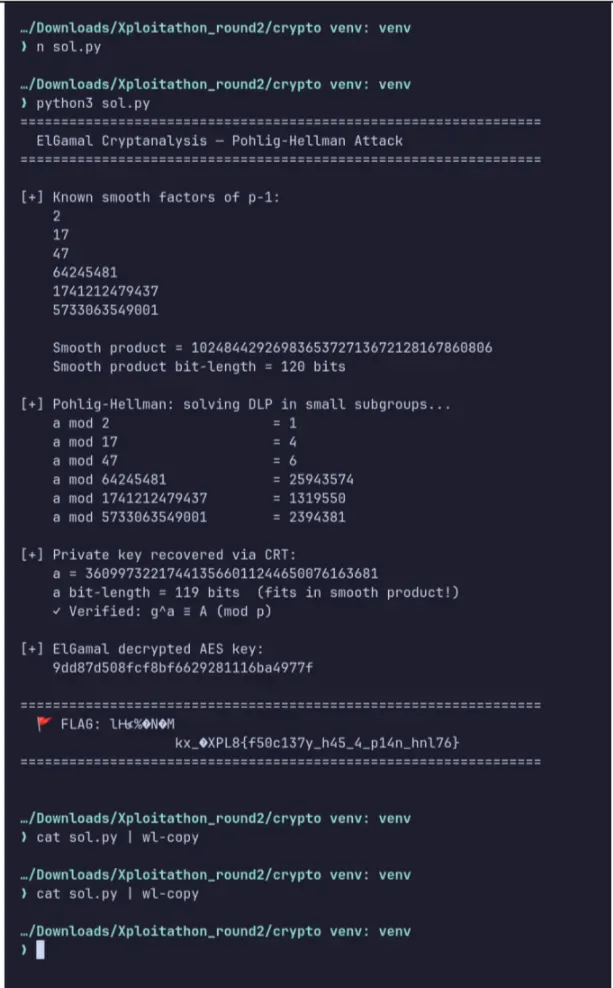
XPL8{f50c137y_h45_4_p14n_hnl76}Conclusion
This challenge demonstrated why cryptographic parameter selection is just as important as the encryption algorithm itself. Although ElGamal is considered secure, choosing a prime where p - 1 factors into many small components makes the discrete logarithm problem tractable. By combining Pohlig–Hellman, the Chinese Remainder Theorem, and the recovered AES key, the complete flag could be recovered without brute force.
Flag:
XPL8{f50c137y_h45_4_p14n_hnl76}